Stake out with SitePlan: 3 functions for points, lines and plans
12.03.2026
Electronic measurement in civil engineering
18.03.2026
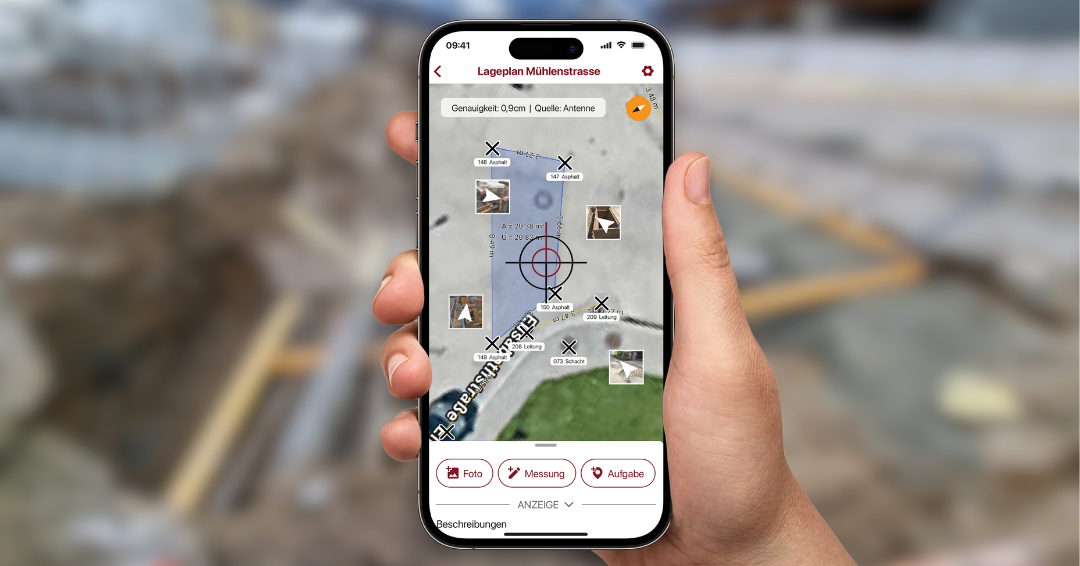
The asphalt is still warm, the pipe trench is about to be filled. The foreman measures with the measuring wheel, someone takes notes. In the evening, the site manager types the values back into the system.
With a GPS measurement and cell phone app, the same process takes a fraction of the time: connect your smartphone to the GNSS antenna, measure the area, done. Quantities calculated, data digital, measurement report ready in 3 clicks.
This guide shows how GPS surveying with smartphones works in civil engineering - and the economic impact.
Why analog measurement becomes expensive
Measure, write down, make a fair copy in the container, coordinate with the client and “digitize”, i.e. scan. For complex geometries in road construction, the rework in the office alone costs 30 to 60 minutes - per measurement.
It is prone to errors on asphalt surfaces with curves, trumpets or recesses as well as varying widths. Systematic rounding errors are reflected in the calculation.
The problem is not the measurement itself. It's the media discontinuity: values on paper, photos on different cell phones, Excel with queries. Each interface costs time and generates errors, and also needs to be reworked when changes or corrections are made.
How does GPS surveying with a cell phone app work?
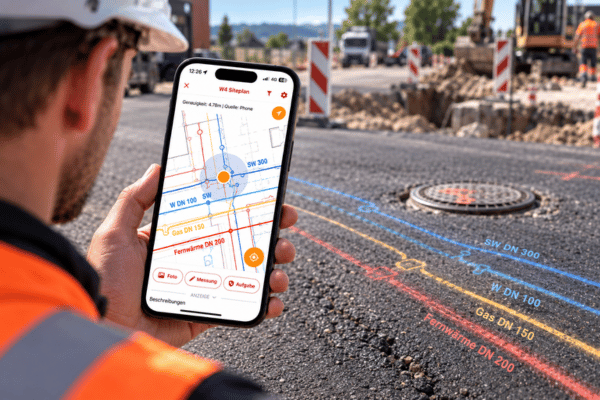
A smartphone with Surveying app is connected to a GNSS antenna via WLan. Points, lines and areas can be measured digitally on site. Quantities are calculated automatically and the data is synchronized in real time with the project and thus with the office.
On the smartphone, you can see your own position directly on the map - like Google Maps navigation, with maps in the background.
Smartphone GPS or GNSS rover? Pure smartphone GPS: Accuracy in the meter range. Sufficient for GPS photo documentation.
Step by step: Digital measurement on the construction site
Open project. Plans (PDF, DXF, DWG) are stored. The foreman only needs his smartphone.
Record area or line. Follow the object and measure it point by point. The app saves the coordinates. And determines the area or length directly on the cell phone
Automatic calculation. Lengths and areas in real time. No splitting into triangles, no recalculating. No transferring the data to the USB stick and post-processing in a CAD program.
Export. As .PDF, .PDF measurement report or DXF for CAD for further processing - with just a few clicks. No manual transfer of data, no need for queries between site manager and foreman.
Where GPS surveying helps in road construction
Asphalt surfaces. Irregular geometries are the classic source of error in measuring wheels. Digital recording eliminates rounding errors. Positional allocation of the partial surfaces. No surfaces are overlooked.
Line construction. Document pipe trenches and routes to the centimeter. Reliable proof of billing.
Shaft positions. Measure exactly, coordinates permanently saved.
Staking out. Mark points from the plan on site - without an external surveyor, without waiting time. The foreman marks out independently.
Smaller projects. This is precisely where the relative cost of analog measurement is highest. One person with a smartphone replaces a two-man team with a measuring wheel and tape measure.
Saving time: analog vs. digital
Analog: 2 people, 1 to 3 hours recording, 30 to 60 minutes rework.
Digital: 1 person, recording parallel to the construction site process, minimal post-processing. Practical values show: up to 5 times faster than with the measuring wheel.
The difference is not only due to faster measuring - but also to the elimination of duplicate work steps: no transfer of paper sketches, no recalculation in Excel, no queries about illegible notes.

Digital processes instead of media discontinuity
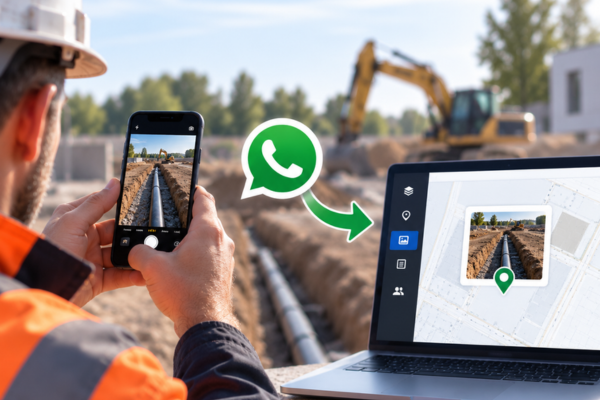
Instead of photos on different cell phones and measurement values on paper, all data is available in a structured format. georeferenced, documented over time, project-related. The site manager sees in the office, what happened on the construction site. Without late-night phone calls, without control trips.
For site managers with several parallel construction sites, this fundamentally changes everyday life. An end-to-end digital process between recording, documentation and invoicing.
Economic impact
Personnel expenses. One person instead of two when measuring. Extrapolated to one year of construction, that adds up.
Surveying costs. Practical values show savings of up to €4,000 per month when foremen take on standard tasks such as setting out themselves.
Billing. Clear billing principles reduce discussions with the client. If quantities, coordinates and GPS photos are available digitally and presented in a comprehensible manner, this reduces the amount of deductions and the construction company receives the money for its construction work more quickly.
Where are the limits?
High-precision special surveying - cadastre, complex engineering surveying - remains a specialist task. However, for typical civil engineering tasks - surveying, line measurement, GPS area measurement and setting out - a smartphone plus GNSS antenna is sufficient and tried and tested.
Decisive: The solution must work without surveying training. If the foreman can work independently after 10 minutes of instruction, the software is suitable for practical use.
From measuring wheel to digital measurement
GPS surveying with cell phone app not only changes the measuring. It changes the entire process between the construction site, site management and invoicing.
No media discontinuity. Less rework. Hardly any discussions about quantities.
In civil engineering, it is not the technology alone that is decisive - but whether it is used in everyday life. When foremen work with smartphones and GNSS antennas without the need for training, a tool becomes an end-to-end digital process.