GPS surveying with mobile app in civil engineering
17.03.2026
Measurement in pipeline construction: digital instead of measuring wheel
18.03.2026

Friday lunchtime, road construction site. 300 meters of sewer laid, two manholes installed, trench can be backfilled. The foreman stands next to the trench with a measuring wheel and field book. Three pages of sketches, handwritten. On Monday, the site manager sits in the office and tries to transfer the figures into Excel. Several details are missing. One figure is illegible. Call back to the foreman - he can't remember.
Analog measurements don't just cost time. It costs money - every time proof is missing and the client doubts and reduces quantities.
The electronic measurement replaces this process with a digital processMeasuring, calculating and documenting in a single work step, all on the construction site.
What is an electronic measurement?
A Electronic measurement in civil engineering means: Quantities are recorded digitally, calculated automatically and stored electronically. Specifically - record points, lengths and areas using the SitePlan app instead of using a measuring wheel and paper.
In contrast to manual measurement, there is no media discontinuity between the construction site and the office. The data is immediately available in digital form and can be downloaded from the web app as Measurement report, as an export file and thus as a basis for billing.
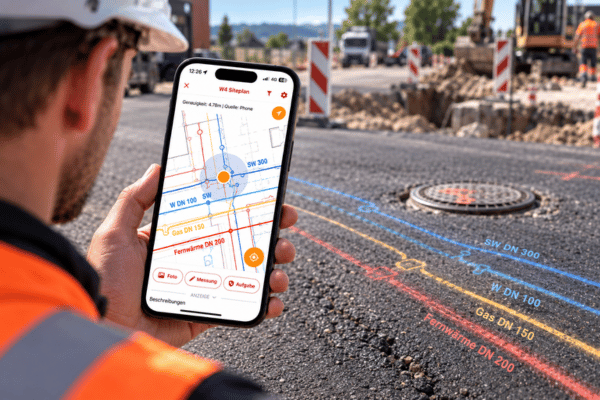
In practice, this works with a smartphone and a GNSS antenna. The SitePlan app records centimeter-accurate position information with GPS data, calculates quantities automatically and can be operated by foremen and site managers without surveying training.
Why electronic surveying is a pressing issue in civil engineering
The requirements for documentation and verification are increasing. Clients are accepting hand-drawn sketches and estimates less and less. At the same time, time pressure on the construction site has never been as high as it is today.
Billing. Without comprehensible quantity determination, no clean billing. If you work with a measuring wheel and paper sketches, you run the risk of having your invoices, supplements or additional cost claims reduced.
Documentation obligation. Pipe runs, manhole positions and intersections with existing pipes must be documented in a comprehensible manner. Paper is no longer enough.
Shortage of skilled workers. External surveyors are expensive and not always available. If standard tasks such as line measurement or staking out can be carried out internally, this saves costs, time and administrative effort.
An electronic measurement is the answer to all three points.
How does electronic measuring work on the construction site?
The process in practice:
Load project. The foreman opens the project on a smartphone or tablet. Plans (PDF, DXF, DWG) are stored in the correct position,
Measuring. Connect the GNSS antenna via WiFi, measure points, lines or areas. The app records coordinates in real time. Position on the plan, immediately visible to all project participants.
Automatic calculation. Lengths and areas are calculated immediately. No transfer of data to the PC, no station calculation in Excel.
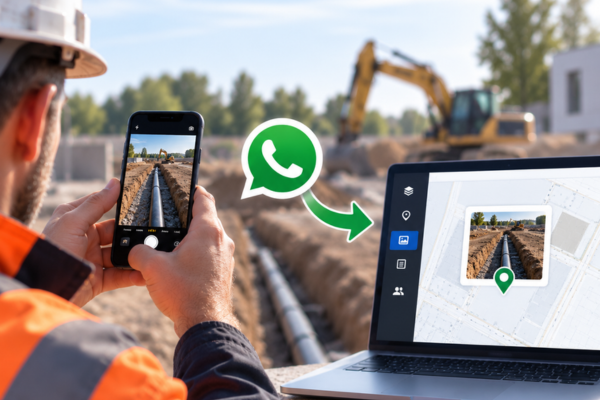
Document. Photos linked with GPS coordinates, time stamp and comment. Everything is georeferenced and saved for each project.
Export. Measurement report as PDF, data as DXF or CSV - just a few clicks. Immediately available in the office, without manual transfer.
The entire process takes a fraction of the time of the analog process. One person instead of two, measurements parallel to the construction process.

Electronic measurement vs. classic measurement
Accuracy
Measuring wheel on uneven construction site terrain provides approximate values. Deviations add up over longer distances - 1 % per 500 meters is 5 meters. A noticeable amount when billing by the meter.
Electronic measurement with GNSS antenna and SitePlan app brings 1 cm accuracy to the construction site. Regardless of uneven terrain, regardless of the length of the route.
Speed
Analog: 2 people, 1 to 3 hours recording, 30 to 60 minutes rework.
Electronic: 1 person, recording continuously with the construction process, hardly any post-processing. Practical experience: 80% faster.
Security of evidence
Paper sketch: difficult to follow, not georeferenced, easy to dispute.
Electronic measurement: coordinates, time stamp, GPS photos. Reliable for discussions with the client, for supplements and in the event of a dispute.
Where electronic surveying has the greatest leverage in civil engineering
Road construction
Asphalt surfaces with curves, partial surfaces and edge areas - the classic source of errors when working manually. Road survey. GPS area measurement eliminates rounding errors and estimated values.
Pipeline construction
Routes, fittings, socket pieces, manhole structures. Each item is georeferenced - before backfilling. Anything that is not measured does not exist for billing purposes.
Cable and fiber optic construction
Long routes, many house connections, tight time frames. Electronic measurement keeps up with the speed of the column. No backlog due to analog documentation.
Staking-out
Points from the plan Mark on site - without a surveyor, without waiting time. The foreman stakes out independently, the crew continues working. Practical values: savings of up to €4,000 per month in external surveying costs.
Objections - and what lies behind them
„Our foremen are not tech-savvy.“ It is crucial that the solution is as simple as Google Maps, for example. If the foreman can measure independently after 10 minutes of instruction, the software is suitable for practical use. Practical experience with SitePlan shows: Even foremen on the verge of retirement can cope.
„We do it manually - it works.“ Works - until the client reduces the quantities because the evidence is not comprehensible. Or until the rework in the office costs more time than the recording on site.
„Is it worth it given the size of our company?“ The relative cost of analog measurement is particularly high for small and medium-sized civil engineering companies. Savings can be seen from the very first project.
Economic effects
- Personnel expenses. One person instead of two for measuring. Hundreds of man-hours saved per year of construction.
- Surveying costs. Carry out line measurement and staking out independently instead of hiring an external company.
- Billing security. Digital evidence with coordinates and GPS photo documentation. Fewer cuts, fewer discussions, faster money.
Rework. No transferring sketches, no recalculating, no queries. The hurdle of digitalization between the construction site and the office is eliminated.
Introducing electronic measurement
Anyone still working with a measuring wheel and tape measure in civil engineering pays twice: with working time and with a lack of billing bases.
Electronic surveying is not a dream of the future. It is a tool that works today - with a smartphone, GNSS antenna and the SitePlan app, developed for everyday use on construction sites.
The question is therefore not whether, but how many paper sketches still have to end up in the dustbin before electronic measurements become part of everyday working life.